 Case study · Space operations
When a spacecraft misbehaves, answers can’t take hours.
We built OCAI Next Generation for the European Space Agency: a multi-agent assistant that helps ESOC operators resolve anomalies faster — with every answer traced back to the ESA documentation and telemetry behind it.
Your challenge
The search worked. The analysis was still manual.
During a spacecraft anomaly, operators cross-referenced live and historical telemetry, dense Flight Operation Procedures and anomaly databases by hand.
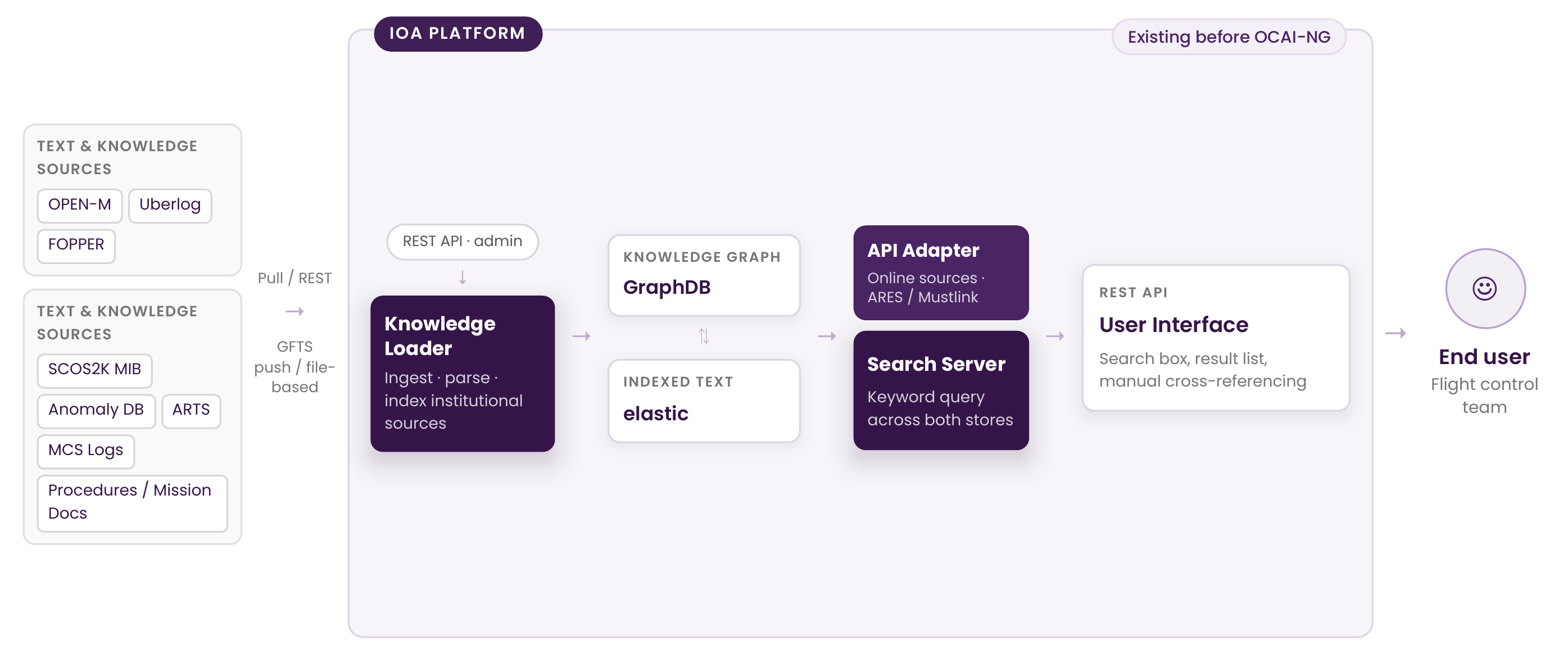
ESA already ran OCAI 2.0, with semantic search across 15 institutional sources. But the sheer volume of results still forced lengthy manual analysis — and every extra minute pushed up Mean Time to Resolution.
The brief: add AI on top of what already worked, not start again.
Live and historical telemetry
Thousands of parameters to compare against past behaviour.
Flight Operation Procedures
Dense, safety-critical documents to find and interpret.
Anomaly databases
Has this happened before — and what fixed it?
Our solution
Search returned documents. Agents return answers.
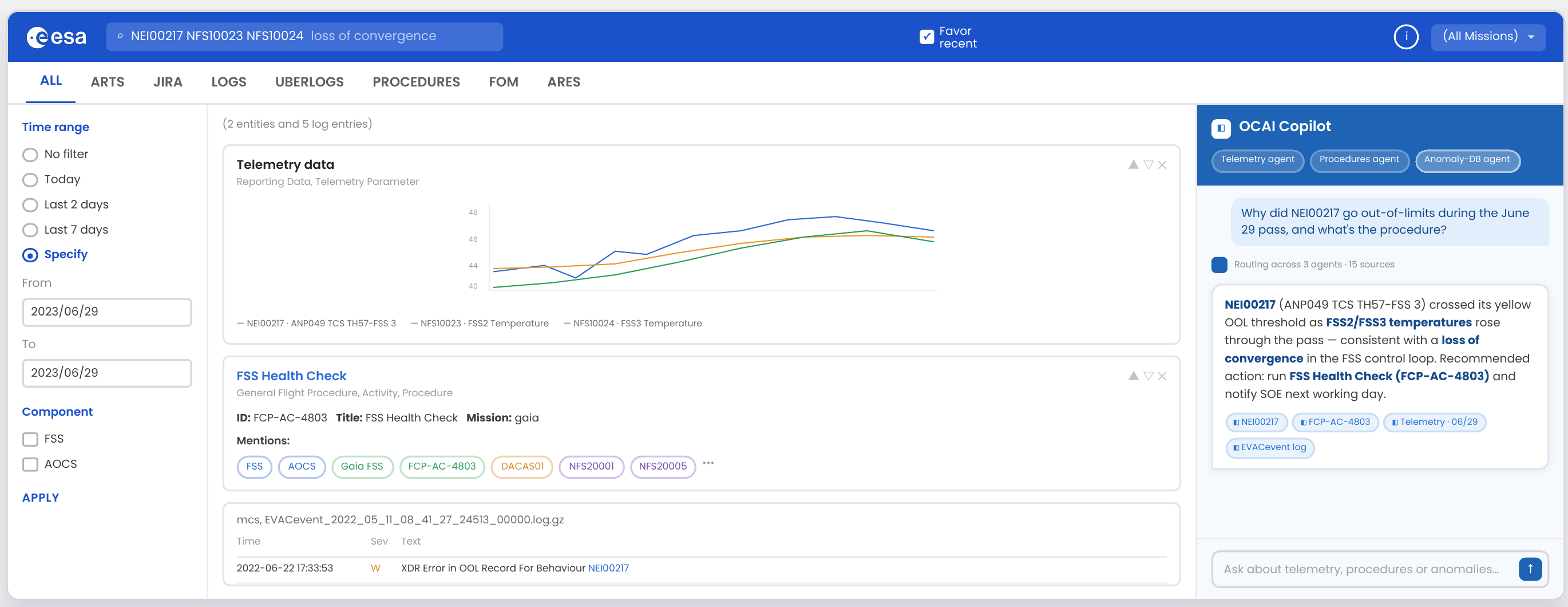
OCAI NG is a multi-agent assistant layered onto the existing mission-operations workspace. Operators ask in plain language and get one synthesised answer — not a pile of results to read through.
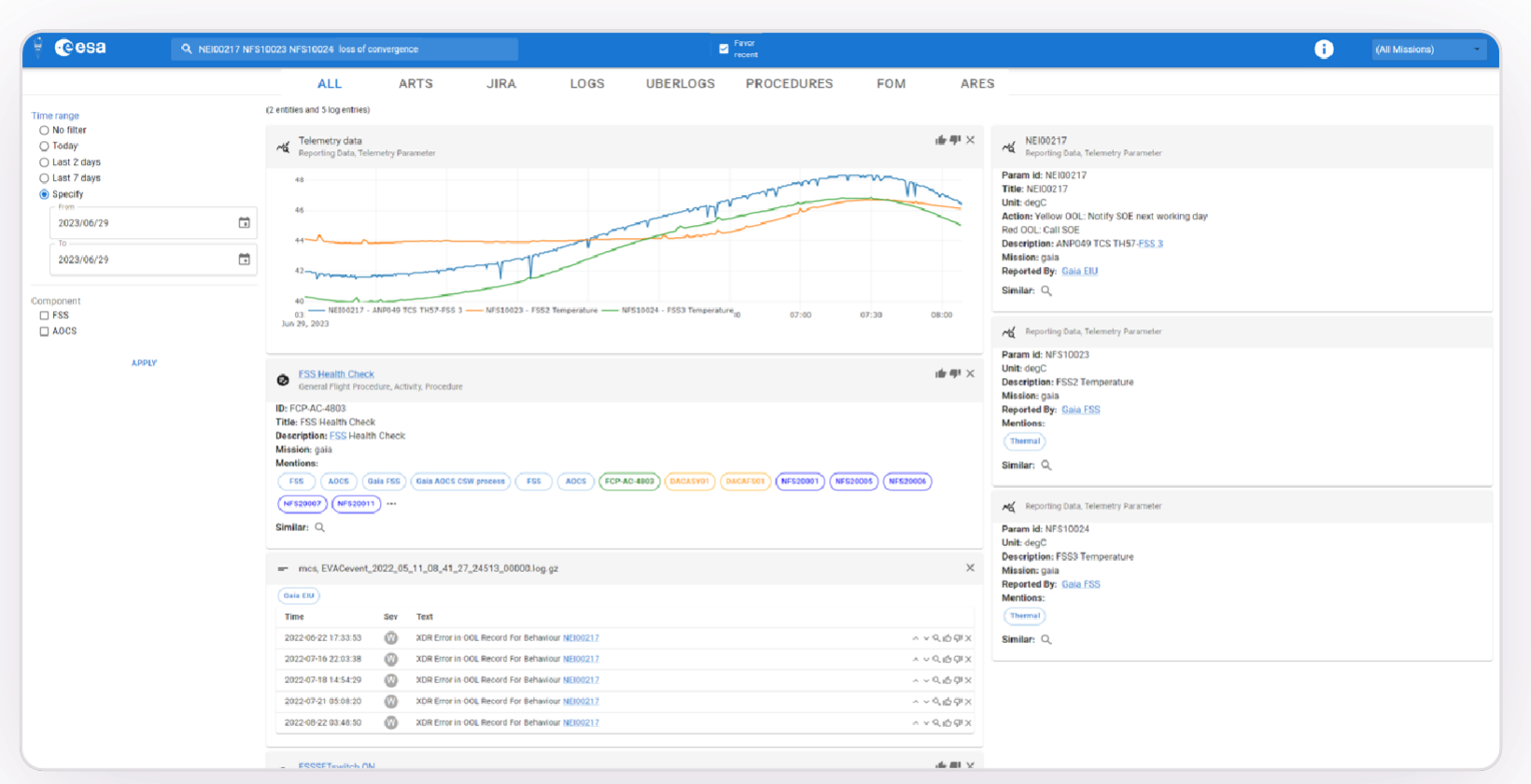
- One query, results grouped source by source
- Keyword search downstream of the search server
- Operators connect telemetry, procedures and past anomalies themselves
- Correlation takes hours
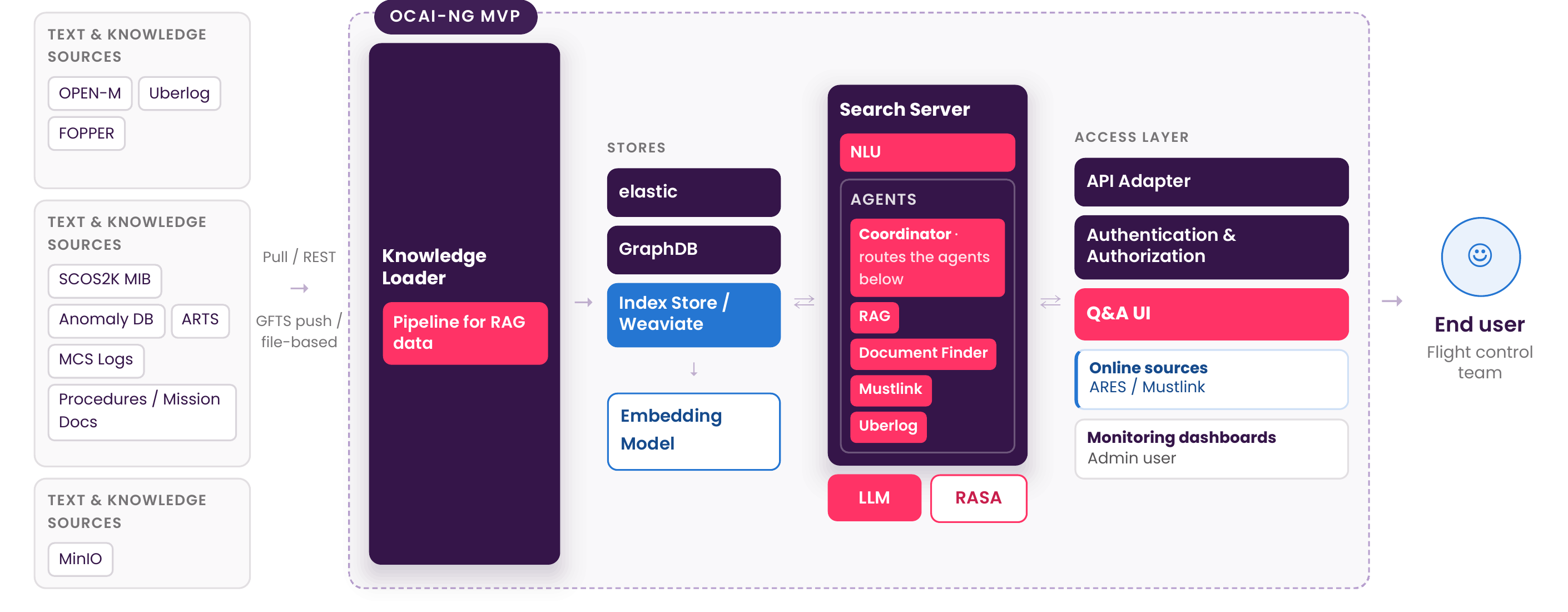
- A coordinator routes each question to specialised agents
- Telemetry, procedures, anomaly records, logs, JIRA and ARES synthesised into one answer
- Every statement cites the ESA source behind it, so operators verify before they act
- Correlation takes minutes
How it works
One question. Specialist agents. One answer you can verify.
Simplified view. The full MVP architecture is shown in the project gallery below.
Built for mission operations
Where a confident wrong answer is worse than no answer.
Grounded by design
Enterprise agentic RAG with strict institutional guardrails. Every response cites its sources, which reduces hallucination risk and keeps operators in control.
Nothing leaves ESA
Runs fully on-premise on open-source models. Mission data stays inside ESA’s own infrastructure — no external AI provider involved.
Layered, not replaced
Built on top of OCAI 2.0 and the platform that already indexed ESA’s institutional sources. Operators kept the tools they trust.
Inside the project
From grouped results to grounded answers.
The results
In production across ESOC — not stuck in a pilot.
Telemetry-to-procedure correlation, the slowest step in anomaly analysis.
In use at the European Space Operations Centre.
Reduced hallucination risk: responses point to ESA documentation and telemetry.
Adoption and time-to-answer tracked mission by mission.
Stop searching.
Start resolving.
Your experts lose hours to documentation, live data and past cases spread across systems? Let’s talk about what grounded, on-premise agents can do for your operations.